
When sourcing brushed stainless steel sheets for architectural or decorative projects, you’ll inevitably encounter two of the most frequently specified finishes: Hairline (HL) and No.4 Satin. At first glance, they look remarkably similar—both feature linear brush marks, both offer a matte-to-semi-gloss appearance, and both are widely used in interior design. But beneath the surface, these two finishes have distinct differences in manufacturing, visual texture, reflectivity, scratch concealment, and practical applications.
As an experienced decorative stainless steel surface finishing factory based in China, we’ve helped countless architects, fabricators, and project managers navigate exactly this choice. In this comprehensive guide, we’ll break down everything you need to know about Hairline vs. No.4 Satin finish—so you can make the right decision for your next project.
What is Hairline Stainless Steel (HL)?
Hairline finish, often abbreviated as HL, is a refined brushed surface characterized by fine, long, continuous linear grains that run uniformly in a single direction. The name comes from the visual resemblance to strands of human hair—delicate, closely spaced, and highly directional.
The Manufacturing Process
The Hairline finish is produced through a precise mechanical polishing process. Typically, the stainless steel sheet undergoes a two-stage abrasive treatment: first, it is polished using a 150–180 grit abrasive belt or wheel to establish the primary grain; then, it is softened with an 80–120 grit greaseless compound or a medium non-woven abrasive belt to refine the texture. The process requires continuous abrasive polishing from edge to edge, ensuring that the lines run uninterrupted across the entire sheet surface. Because the grain continuity must be maintained flawlessly—any interruption ruins the effect—Hairline finishing demands higher setup time, greater operator skill, and stricter quality inspection compared to other brushed finishes.
Visual Characteristics
A Hairline finished stainless steel sheet presents a clear, sharp, highly directional texture with moderate reflectivity. The lines are finer and more closely spaced than those of a No.4 finish, creating a sleek, modern aesthetic. The surface retains approximately 85% of stainless steel’s natural reflectivity while minimizing harsh glare—striking an ideal balance between brilliance and subtlety. This makes Hairline finish particularly well-suited for environments where both visual elegance and reduced light reflection are desired.
📸 Visual Reference: Hairline finish—continuous long grains with a refined, modern sheen.
What is No.4 Satin Finish?
No.4 Satin finish—also referred to simply as No.4 finish or brushed finish—is the industry workhorse of decorative stainless steel surfaces. It is defined by short, uniform, parallel polishing lines running along the length of the sheet or coil, producing a softer, more muted appearance than Hairline.
The Manufacturing Process
The No.4 finish is achieved by mechanically sanding the stainless steel surface with abrasive belts in a controlled, directional manner. The process typically uses #150–#180 grit abrasives to create a consistent linear grain pattern-
. Unlike Hairline, which requires uninterrupted grain lines across the entire sheet, No.4 finish can be processed both in coil form and sheet form—coil processing offers higher efficiency and lower unit cost, making No.4 a more cost-effective choice for large-volume projects.
Visual Characteristics
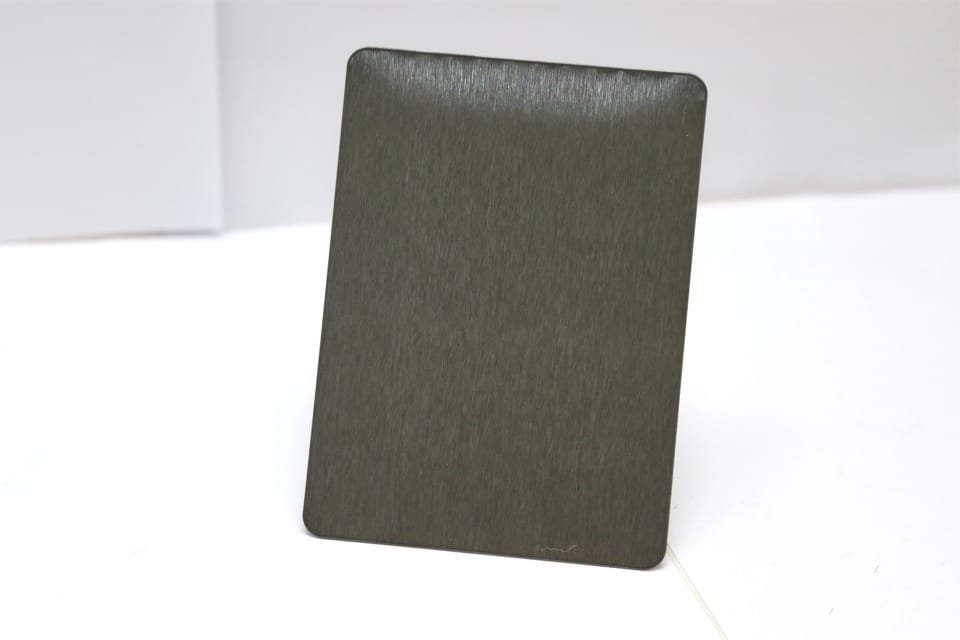
No.4 Satin finish delivers a soft, matte, low-reflection appearance with a warm, almost pearl-like quality. The short grain lines produce a muted satin sheen rather than a sharp directional shine. This softer aesthetic makes No.4 finish exceptionally versatile—it feels understated and elegant without drawing excessive attention to itself. Its ability to diffuse light rather than reflect it directly makes it ideal for applications where glare reduction is a priority.
📸 Visual Reference: No.4 Satin finish—short, uniform grains with a soft, muted sheen.
Head-to-Head Comparison: Hairline vs. No.4 Satin
To help you quickly distinguish between these two finishes, here’s a side-by-side comparison of their key attributes:
| Feature | Hairline (HL) Finish | No.4 Satin Finish |
|---|---|---|
| Grain Pattern | Long, continuous, unidirectional lines | Short, uniform, parallel lines |
| Grit Size | 150–180 (refined with 80–120) | 150–180 |
| Surface Roughness (Ra) | 0.2–0.5 µm | 0.4–0.6 µm |
| Reflectivity | Moderate (≈85% of natural reflectivity) | Low (soft matte) |
| Visual Texture | Sharp, clean, directional | Soft, muted, warm |
| Fingerprint Hiding | Good | Very good |
| Scratch Concealment | Moderate (scratches parallel to grain hide well) | Excellent (short grain lines scatter light effectively) |
| Processing Cost | Higher (requires stricter quality control) | Lower (can be processed in coil form) |
| Common Applications | Architectural facades, wall cladding, elevator doors | Kitchen equipment, commercial interiors, high-traffic panels |
Appearance & Reflectivity
The most immediate difference between Hairline and No.4 Satin lies in how they look and reflect light. Hairline finish features longer, more continuous grains that create a clean, modern, almost architectural aesthetic—visually crisp and directional. Its moderate reflectivity gives it a polished yet not overly glossy appearance. No.4 Satin, by contrast, offers a softer, more uniform surface with lower reflectivity. The short grain lines produce a gentle matte finish that feels warmer and less industrial.
Scratch Concealment & Maintenance
This is where the two finishes diverge significantly. No.4 Satin finish is superior at hiding daily wear and tear. The short, interrupted grain pattern effectively scatters light and masks minor scratches, fingerprints, and smudges—making it an excellent choice for high-traffic environments like commercial kitchens, elevator interiors, and public lobbies–. The directional grain helps to hide scratches that run parallel to the lines, and the matte surface reduces the visibility of oils and residues.
Hairline finish, while elegant, is more delicate. Because its grains are long, fine, and continuous, any scratch perpendicular to the grain direction becomes immediately noticeable. The refined texture also shows fingerprints more readily than No.4 Satin. For applications where the surface will see frequent human contact, No.4 Satin is generally the more practical choice.
Cost & Production Efficiency
From a manufacturing perspective, the cost difference between Hairline and No.4 Satin is not dramatic—but it is real. Hairline finish typically commands a higher price due to its more stringent processing requirements. Maintaining uninterrupted grain lines across the entire sheet demands longer setup times, more skilled operators, and tighter quality inspections. No.4 Satin, by contrast, can be processed more efficiently—especially in coil form—making it the more economical option for large-scale projects without sacrificing visual quality. That said, the actual price difference depends largely on the quality of the base material and the grade of abrasive consumables used.
Practical Applications: Which One Should You Choose?
Best Uses for Hairline Finish
Hairline finish is the go-to choice when visual precision and a sleek, modern aesthetic are the primary considerations. Its long, continuous grains create a sense of length and directionality that can visually stretch a space. Ideal applications include:
- Architectural facades and exterior cladding – The sharp, directional texture adds a contemporary edge to building exteriors
- Decorative wall panels and feature walls – Hairline’s clean lines make it a favorite for luxury interior accents
- Elevator doors and panels – When a refined, upscale look is desired without the high maintenance of mirror finishes
- Long, linear architectural elements – Door frames, window trims, and column cladding where continuous grain alignment enhances visual flow-
- High-end kitchen appliances and automotive detailing – Where visual appeal is paramount
Best Uses for No.4 Satin Finish
No.4 Satin finish excels in high-traffic, functional environments where durability and ease of maintenance matter as much as aesthetics. Its ability to hide fingerprints, smudges, and minor scratches makes it a pragmatic yet attractive choice. Ideal applications include:
- Commercial kitchen equipment and backsplashes – Resists grease, cleaning chemicals, and daily wear
- Elevator interiors and escalator panels – High-touch areas benefit from No.4’s excellent smudge-hiding properties
- High-traffic corridor kickplates and wall guards – Where constant contact makes scratch concealment essential
- Food processing and healthcare facilities – Hygienic, easy-to-clean surfaces with low glare
- Handrails, signage, and commercial furniture – Balances aesthetics with real-world durability
Quick Selection Rule: Choose Hairline when your priority is visual impact—sharp, clean, directional aesthetics for low-touch, high-visibility applications. Choose No.4 Satin when your priority is practicality—durability, low maintenance, and excellent performance in high-traffic environments.
Elevate Your Finishes with PVD Colors & AFP Coating
At Vstmetal, we understand that the right surface finish is only the beginning. Whether you select Hairline or No.4 Satin as your base texture, we offer two premium enhancements that can transform your stainless steel panels from functional to exceptional.
PVD Vacuum Coating – Vibrant, Durable Colors
Physical Vapor Deposition (PVD) is an advanced vacuum-coating technology that deposits a thin, durable ceramic layer onto the stainless steel surface. Inside a high-vacuum chamber, solid metal materials like titanium are vaporized and bonded atom-by-atom to the substrate, creating a finish that is both visually stunning and exceptionally wear-resistant. The PVD coating is ultra-thin (typically just 1–5 microns), uniform even on edges, and highly resistant to UV exposure, corrosion, and scratching.
We can apply PVD coloring over both Hairline and No.4 Satin base finishes, offering a wide palette of vibrant colors:
- Gold – Classic and luxurious, perfect for hospitality interiors
- Rose Gold – Warm, contemporary, and increasingly popular in residential design
- Black Titanium – Bold, modern, and dramatic for high-contrast applications
- Bronze – Rich, earthy tones for warm architectural accents
- Champagne – Subtle elegance with a soft metallic sheen
- Brass and Copper – Vintage-inspired warmth for retro-modern aesthetics
(Our full color range V74–V79 is available on request—please contact us for samples of colored Hairline and No.4 Satin sheets.)
AFP (Anti-Fingerprint) Nano Coating – Effortless Cleanliness
For high-traffic installations where stainless steel is frequently touched—elevator panels, handrails, kitchen splashbacks, and lobby walls—we strongly recommend adding our AFP (Anti-Fingerprint) nano coating. This transparent, nanotechnology-based protective layer forms an ultra-thin barrier on the stainless steel surface that repels oils, water, and dirt.
The benefits of AFP coating are substantial:
- Fingerprint resistance – Smudges wipe away effortlessly with a clean cotton towel or mild detergent like Windex
- Increased surface hardness – Standard stainless steel rates 2H–3H on the pencil hardness scale; after AFP treatment, hardness triples to at least 6H, significantly reducing the risk of surface scratches
- Enhanced corrosion protection – AFP creates a barrier that prevents oxygen and moisture from penetrating the surface, boosting corrosion resistance (tested to 500+ hours salt spray by SGS)
- Laser burn mark reduction – The coating minimizes visible burn marks during laser cutting
AFP is available on both colored and non-colored stainless steel surfaces, including Hairline, No.4 Satin, and embossed sheets. It preserves the original optical characteristics and surface feel while adding significant practical value.
Expert Tip: For commercial kitchens, public elevator lobbies, and hospital corridors, we recommend specifying both No.4 Satin base finish + AFP coating—the combination offers the best possible resistance to fingerprints, scratches, and daily wear.
Conclusion
Choosing between Hairline and No.4 Satin finish ultimately comes down to the specific demands of your project. Hairline delivers a sharp, directional, visually refined aesthetic—ideal for architectural facades, decorative wall panels, and any application where clean lines and modern elegance take center stage. No.4 Satin offers a softer, more forgiving surface that excels in high-traffic environments, hiding fingerprints and minor scratches with ease while maintaining a warm, professional appearance.
And when you’re ready to take your project further, Vstmetal is here to help. Whether you need PVD coloring to add vibrant personality, AFP nano coating for effortless maintenance, or both—we have the technical expertise and manufacturing capability to deliver exactly what you need.
Ready to experience the difference for yourself?
Need to feel the texture, see the grain, and compare the finishes side by side before making a decision? We completely understand—and we’ve made it easy. Click the button below to request your free physical sample box. We’ll send you tangible Hairline and No.4 Satin samples so you can touch, compare, and choose with confidence.